In our studio, the number-one cause of case delays is not inadequate design skill — it is poor scan submissions. Across all cases we receive, approximately one in five requires a clarification request or rescan before design can begin. Every one of those delays costs your practice time, disrupts your schedule, and adds frustration to an otherwise preventable situation.
This is our definitive 12-point QA checklist for STL file submission. Print it. Post it. Make it part of your standard clinical workflow.
Why This Matters More Than You Think
A scan file that passes all 12 points below:
- Requires zero clarification from our team → design starts immediately
- Produces a more accurate restoration with tighter margins → fewer chair-side adjustments
- Reduces revision requests → saves money and time for both sides
- Demonstrates clinical precision that positions your practice as a serious professional partner
Data point: Labs that consistently submit clean, complete files receive their designs an average of 3.2 hours faster than labs with frequent clarification requests — even when the underlying design complexity is identical.
Group 1: Arch Completeness (Items 1–4)
- 1. Prep arch captured to the distal of the last molar — not cropped at the premolar
- 2. Opposing arch complete bilaterally — all posterior teeth present to provide posterior stop reference
- 3. Buccal bite registration at MIP (maximum intercuspation) captured for arch alignment
- 4. For edentulous cases: record bases digitized or alternative occlusal reference provided
Group 2: Margin & Prep Quality (Items 5–8)
- 5. Preparation margin fully visible — no tissue overlap at the finish line
- 6. No artifact voids or "stars" at the margin — rescan the prep area if present
- 7. Margin depth distinguishable from surrounding enamel — shoulder/chamfer clearly differentiated
- 8. Adjacent teeth fully captured — contact areas on mesial and distal must be scannable
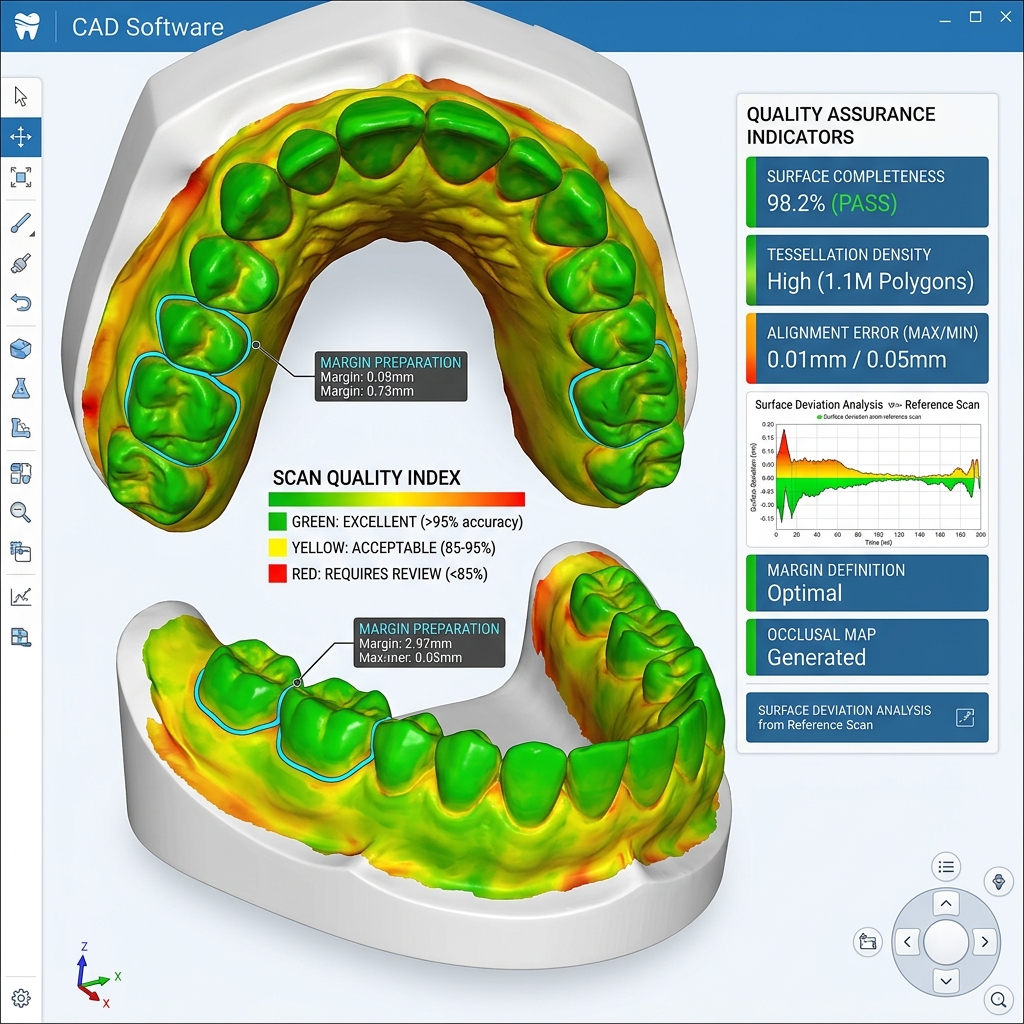
QA heat map analysis in CAD software: green = good scan quality, yellow = borderline, red = rescan needed
Group 3: File & Naming (Items 9–12)
- 9. Files named clearly: prep.stl / upper.stl, opposing.stl / lower.stl, bite.stl — not "scan1.stl"
- 10. Only one file per arch — not multiple overlapping scan sessions of the same arch
- 11. File format confirmed: STL or PLY accepted; DICOM only for CBCT/implant planning
- 12. Case form completed: tooth number, material, shade (if relevant), restoration type, contacts preference
Ready to submit a clean case?
Use our structured upload form — it guides you through every required field before you can submit.
Implant Case Additions (Items 13–16)
For implant-supported restorations, the 12-point checklist above applies in full, plus:
- 13. Scan body fully captured 360° — no tissue or other geometry obscuring the body
- 14. Implant system specified: manufacturer, system name, platform diameter (e.g., Straumann BL 4.1)
- 15. Scan body reference number provided (e.g., SB-NC-3.3) — not just "Straumann"
- 16. CBCT/DICOM provided for cases with angulated implants or guided surgery planning
A submission that clears all 16 points for an implant case and all 12 points for a restorative case is a submission we design without interruption. That's 8–12 hours of production time, delivered efficiently, with precise results your patients can trust.