Every month, a new company announces that AI will "revolutionize" dental CAD. Some of these announcements are genuine breakthroughs. Most are marketing. In this article, we separate what AI in dental design currently does well from what remains aspirational — and how forward-thinking labs should position themselves for the transition that is genuinely coming.
What AI in Dental CAD Actually Does Today
Artificial intelligence in dental CAD is not theoretical — it is embedded in several commercial products already in clinical use. But it's important to have an accurate picture of what it does and what it does not yet replace:
| AI Capability | Current Status | Maturity |
|---|---|---|
| Automated margin detection | Available in 3Shape, exocad add-ons | ⭐⭐⭐⭐ |
| Tooth morphology proposal (anatomy generation) | Available, requires manual refinement | ⭐⭐⭐ |
| Contact optimization | Semi-automated in most platforms | ⭐⭐⭐⭐ |
| Occlusal equilibration simulation | Research phase | ⭐⭐ |
| Full autonomous crown design without review | Not available for clinical use | ⭐ |
| AI-powered scan quality analysis | Emerging (DentalMonitoring, Apteryx) | ⭐⭐⭐ |
Reality check: No AI system today produces a design file that can be sent to the mill without human review. The role of AI is to accelerate and augment the human designer — not replace them.
AI Margin Detection: The Most Mature Application
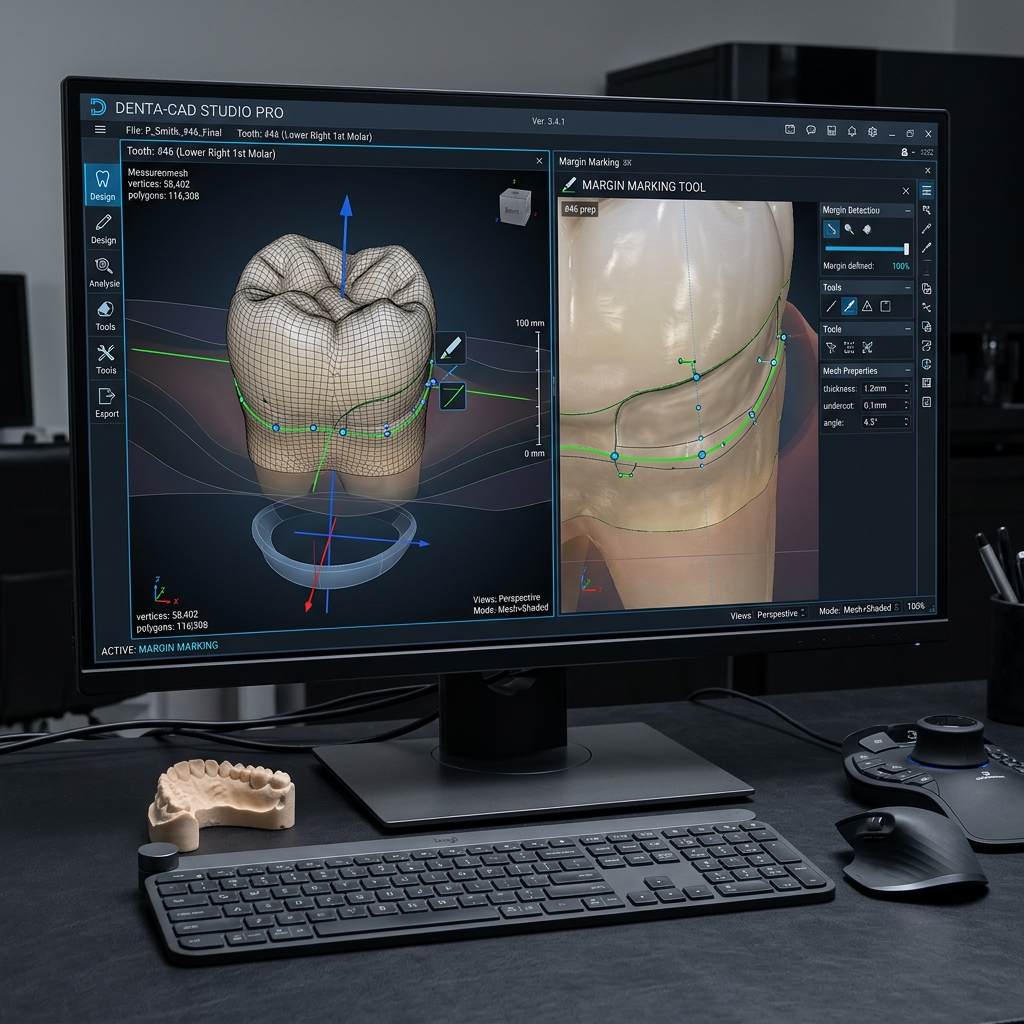
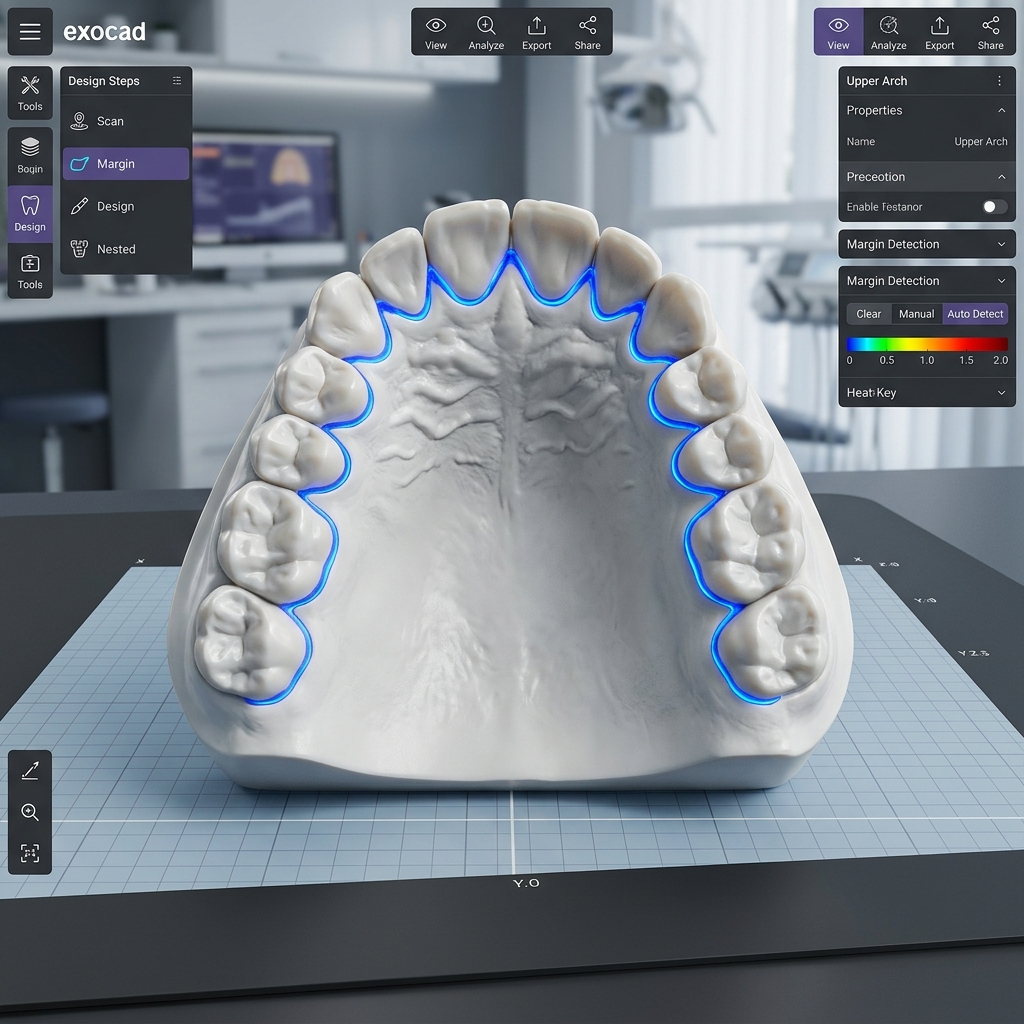
Automated margin detection — where the AI identifies the preparation finish line from a scan file — is the area where AI has made the most tangible clinical impact. 3Shape's AI-powered margin detection, available since 2022, can identify margins in clear scans with an accuracy that rivals experienced designers.
The key limitation: AI margin detection still struggles with subgingival margins, ambiguous finish lines, and scan artifacts. In these cases — which represent a significant portion of real-world cases — human judgment remains superior.
In our studio, we use AI margin suggestions as a starting point and refine manually. This saves approximately 3–5 minutes per case while maintaining quality standards we'd never compromise on.
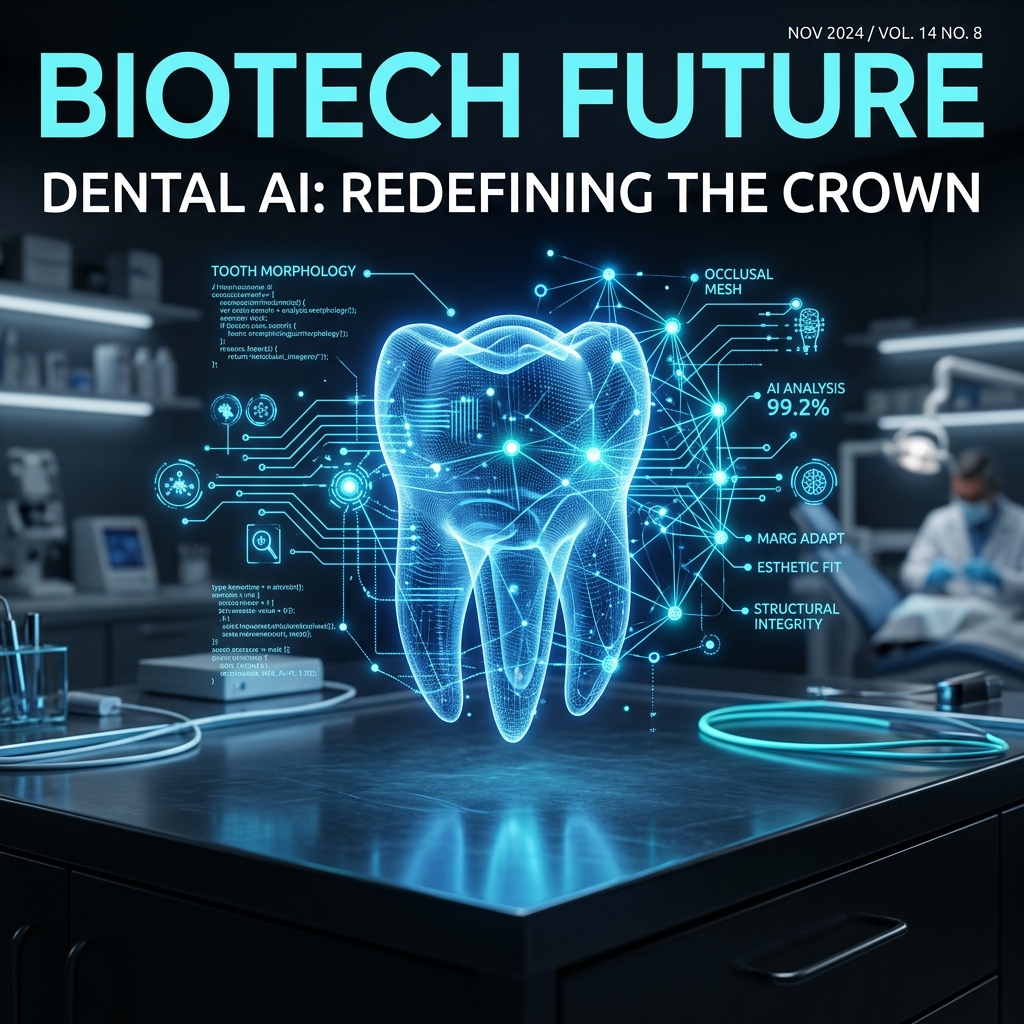
The future of dental AI: real-time design assistance, not autonomous replacement of clinical judgment
AI Tooth Morphology Proposals
Several platforms now offer AI-generated tooth anatomy proposals — where the software proposes an initial crown shape based on the opposing arch, adjacent tooth anatomy, and a database of ideal tooth morphologies. This is commercially available in Exocad and 3Shape.
Clinical reality: AI morphology proposals are useful starting points for posterior restorations with standard anatomy. For anterior teeth, esthetic cases, and any restoration where individual patient anatomy matters significantly, AI proposals require substantial manual refinement. They are a time-saver, not a design replacement.
AI in Quality Control: An Underappreciated Application
One of the most practical near-term AI applications is in design QA. AI systems can be trained to flag:
- Connector cross-sections below minimum thresholds for specific materials
- Wall thicknesses that will cause milling failures
- Occlusal contacts that exceed design specifications
- Margin gaps outside defined tolerances
This type of AI-assisted QA is already available in basic form within milling center software like Millbox. As it matures, it will dramatically reduce the rate of milling failures and remakes across the industry.
Work with designers who embrace innovation
Our team actively incorporates AI tools where they genuinely help — and applies expert judgment where they don't.
What's Genuinely Coming in the Next 3–5 Years
Based on current research trajectories and commercial development pipelines, we expect to see these developments become clinically relevant within the next 3–5 years:
- Predictive occlusal wear modeling — AI that designs restorations accounting for the patient's bruxism patterns and occlusal forces based on historical data
- Real-time scan quality feedback — your intraoral scanner flagging margin quality during scanning, before you've left the operatory
- AI-assisted treatment planning integration — where restorative design, implant planning, and orthodontic planning are linked in a single AI-informed workflow
- Generative design for complex prosthetics — AI generating structurally optimized framework geometries for implant bars and complex bridges
How Forward-Thinking Labs Should Prepare
- Digitize now, not later — AI tools are only accessible to labs already using digital workflows. Film, PVS impressions, and analog workflows will not benefit from AI innovation.
- Standardize your data — clean, consistent, well-labeled scan data trains better AI tools and produces better outputs from AI-augmented design
- Work with studios that use AI tools already — the per-case time savings from AI-assisted design flow through to your turnaround times
- Don't over-invest in hardware that AI will disrupt — scan-to-mill workflows may be significantly compressed by AI; be cautious about 5-year milling equipment investments
- Invest in clinical communication skills — as the technical execution becomes more automated, the ability to understand and communicate clinical requirements becomes the core competency that differentiates excellent outcomes
AI will not eliminate the need for experienced dental CAD designers. It will eliminate the need for mediocre ones. The labs and studios that combine clinical expertise with intelligent use of AI tools will produce better restorations, faster, at lower cost — and that outcome benefits everyone in the chain, from designer to clinician to patient.